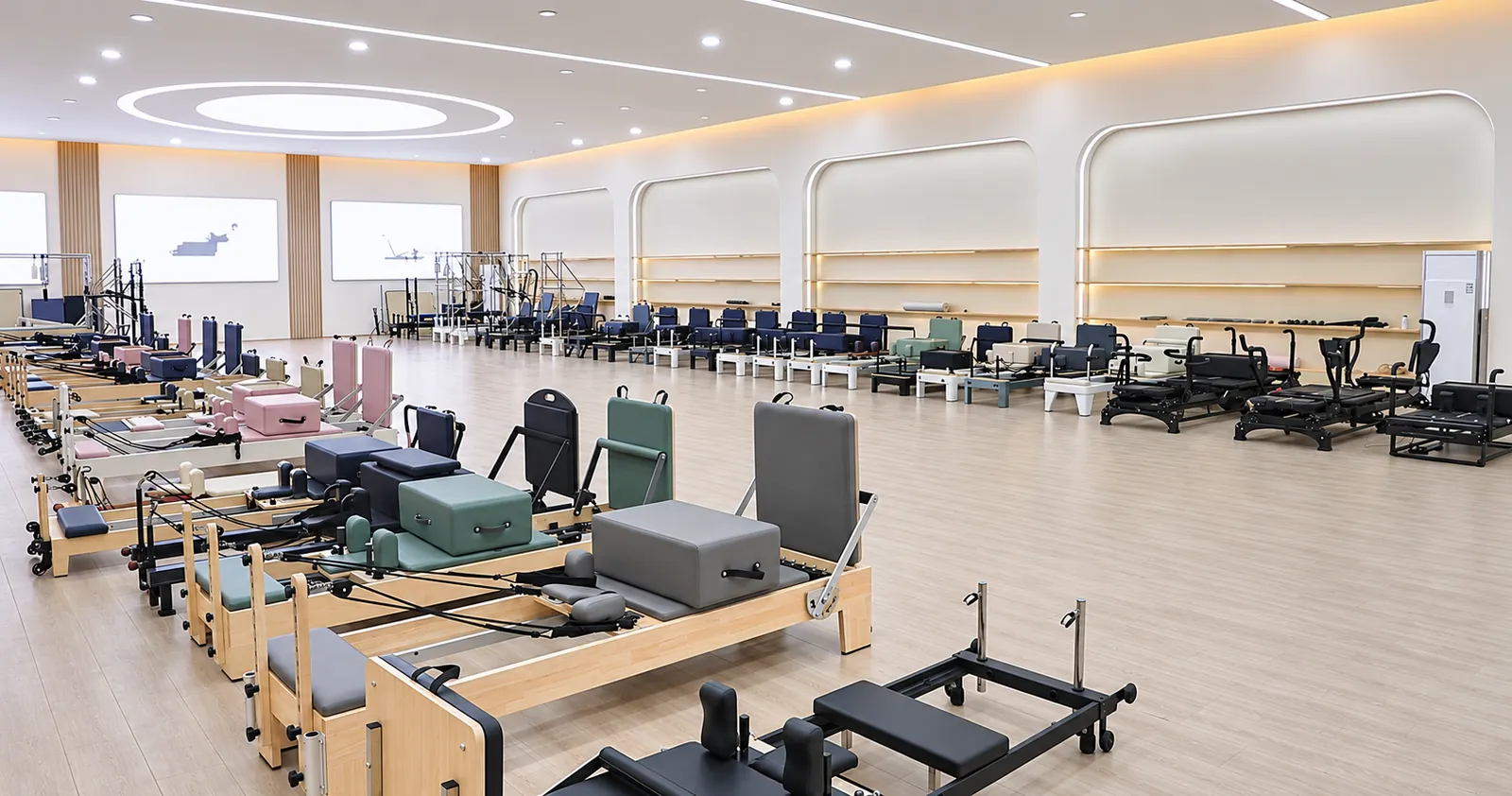
A boutique studio usually runs six to twelve stations in one room, with classes back to back through the day. That changes the question. You are not choosing one machine; you are choosing a floor, and every station will be used by a different client every hour. This guide goes through the decisions in the order we suggest making them, using the published specifications of our own range as worked examples.
Start with the room, not the catalogue
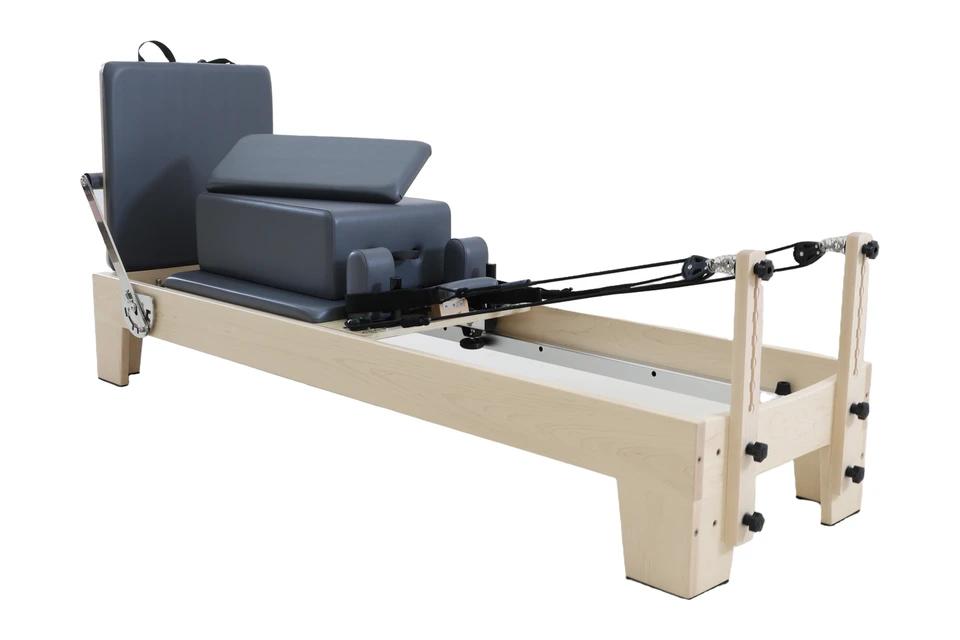
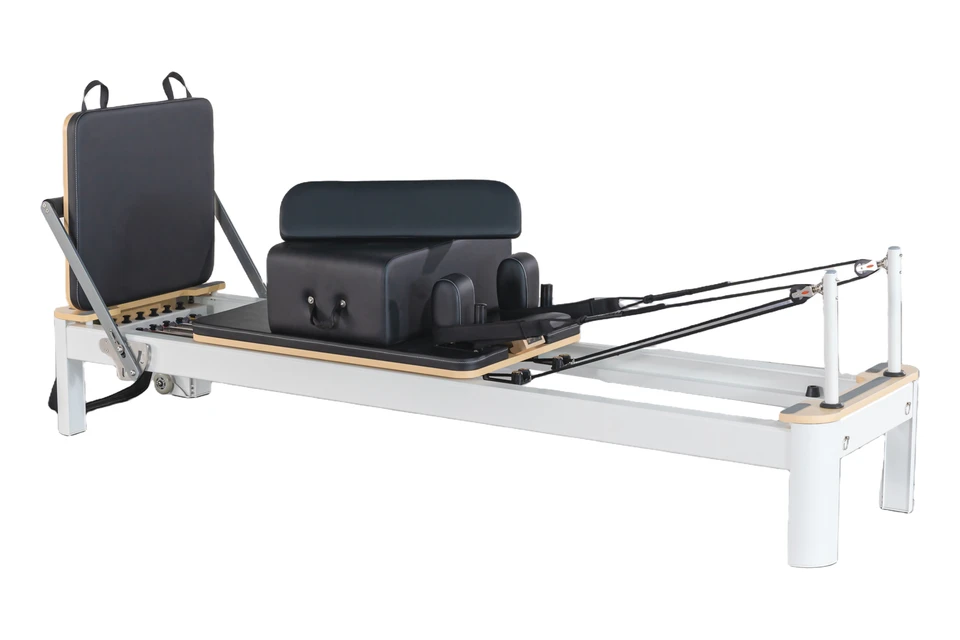
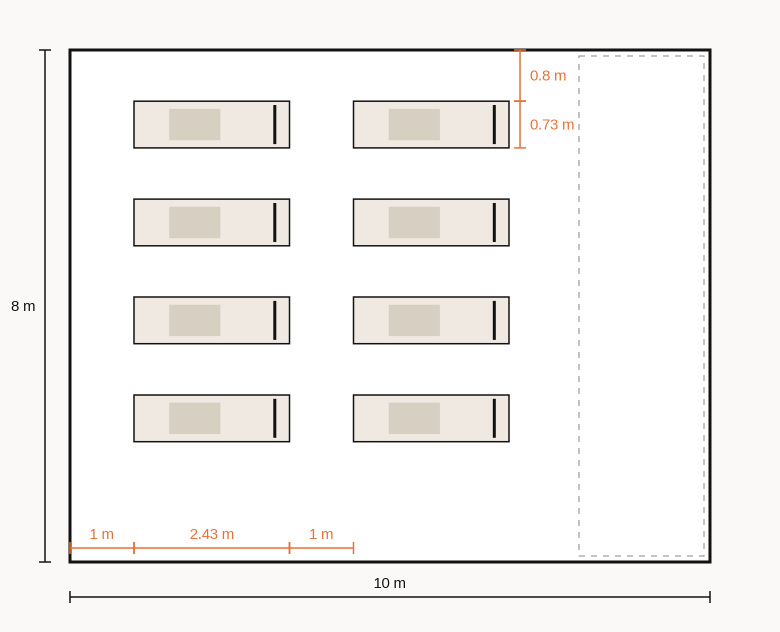
Most flat reformers in our range are 2.4 to 2.5 metres long and 0.66 to 0.97 metres wide. The length barely changes from model to model; the width does, mainly because of the track design. Full-track models such as the Aluminium Alloy Full-Track Reformer are 920 mm wide, while a standard maple or oak reformer is 730 mm.
To estimate station count, add the space you want between machines and the aisles you want at each end, then divide it into the room. Decide the spacing with your lead instructor: they know how much room they need to walk the floor and make hands-on corrections.
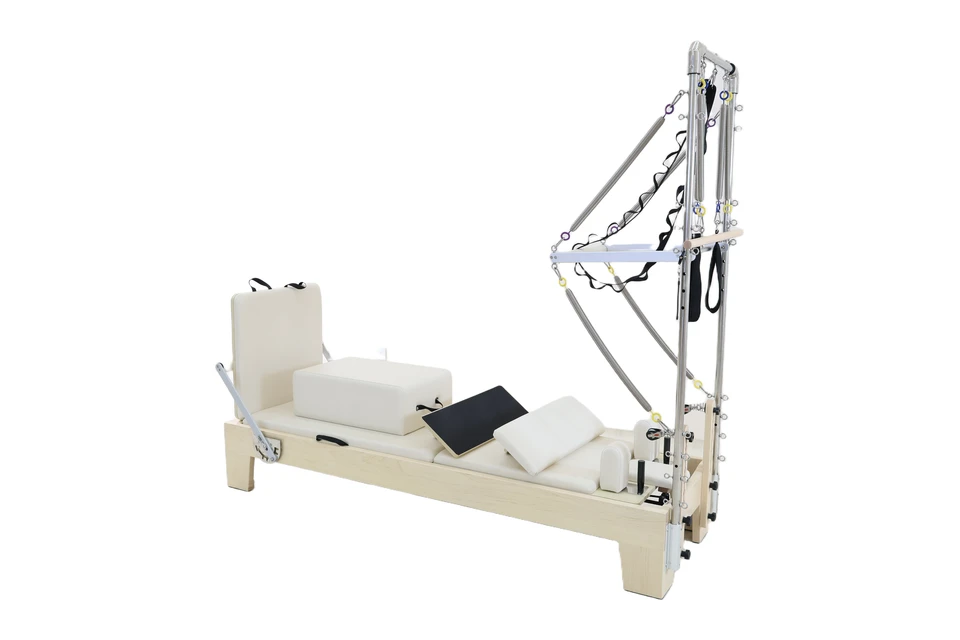
If you are considering tower models, measure the ceiling as well. Our reformers with a half tower stand 1.86 to 2.02 metres tall, and a full Cadillac 2.03 to 2.12 metres. Check for light fittings, ceiling fans and sloping ceilings above where the frames will go.
Flat reformer, reformer with tower, or a mix
A tower adds a vertical frame at the head of the reformer with a push-through bar, a roll-down bar and extra spring attachment points. It widens the exercise repertoire without adding floor area, because a half-tower model has the same footprint as the flat version: the Maple / Oak Reformer with Tower measures 2,430 × 730 mm on the floor, exactly like the flat Maple / Oak Reformer.
What it does change is height, weight and price, and it makes a room feel busier. Many studios therefore mix: tower models for small-group classes that use them, flat reformers for the rest, and one Cadillac for private sessions. Plan your timetable first, then count how many tower stations it actually needs.
Frame material: aluminium or wood
We build reformers in aircraft-grade aluminium alloy and in North American maple, Thailand oak and walnut. In our range the choice is less about weight than people expect — the lightest aluminium and wood reformers are within a few kilograms of each other — and more about the look of the room, the track, and how the frame behaves in your climate. We cover this in detail in Wood or aluminium: how the frame changes a Pilates reformer.
For a boutique floor the practical point is consistency. Clients notice when one station looks or feels different from the next, so pick one model and one finish for the whole room if you can.
Carriage height and track width
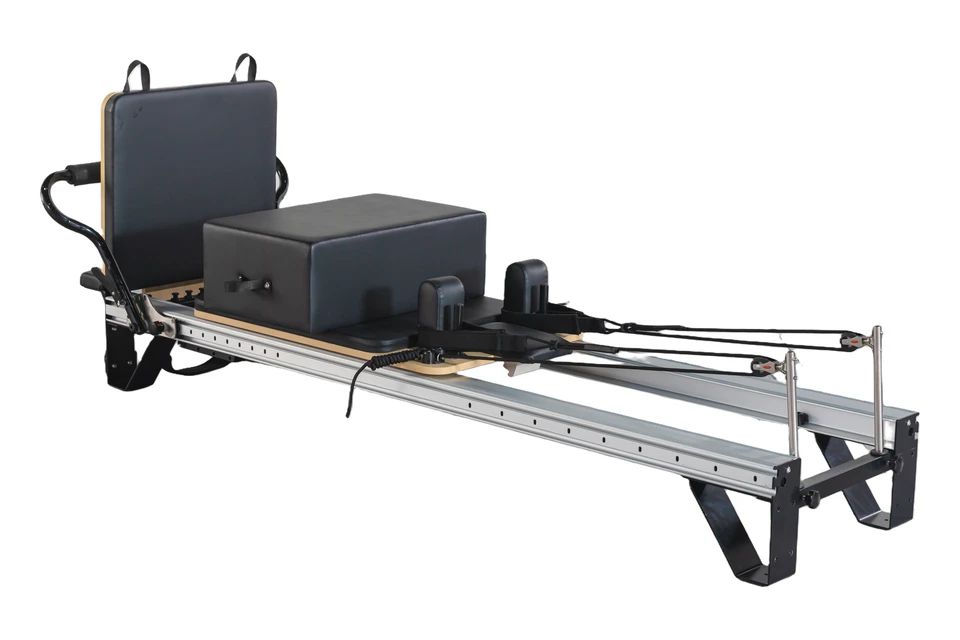
Reformers come at different heights. A low frame keeps the room visually open and suits athletic classes. A raised frame puts the carriage closer to knee height, which many instructors prefer for clients who find it hard to get down to floor level and back up. In our range, low-frame models such as the Fourth-Generation Aluminium Alloy Reformer are 370 mm high overall, while the flat square-leg models stand 740 mm high.
Track width affects the station count, as above, and how stable the carriage feels to the client. Wide, full-track designs take more floor; standard tracks let you fit more stations into the same wall length. On our wood reformers the track is stainless steel; on the aluminium models it is aluminium alloy.
Look closely at the parts that take the wear
In a busy studio the frame is rarely what fails first. Springs, upholstery, straps and wheels do the work every session, so these are the specifications worth asking any manufacturer about in writing:
- Springs — what wire they are made from and how they are attached. Our core reformer range uses German imported piano-wire springs.
- Upholstery — the leather or vinyl specification and the foam underneath. Ours is three-layer water-washed microfiber leather, wear-resistant and anti-slip, over EVA foam.
- Hardware — the grade of the bolts, hooks and fittings. Ours are 304 stainless steel throughout.
- Wheels — the carriage should run quietly and smoothly; ours use high-elasticity silent wheels.
- Warranty — what is covered and for how long. Our frames carry a 5-year warranty and parts a 1-year warranty.
Also ask for the safety standards the equipment has been tested to. Our equipment is tested to the EN ISO 20957 series of fitness equipment safety standards, and the declaration of conformity and test documentation are available on request.
Try one machine before you fit out the floor
Our minimum order is one unit, so a sensible approach is to order a single machine, let your instructors teach on it for a few weeks, and only then order the rest of the floor. In-stock models ship in 5–10 days; if you are specifying custom leather colours, a logo or different dimensions, the lead time is quoted with the order. Before anything is packed, we send photos and video of the finished machines for you to confirm.
Checklist before you order
- Room plan drawn to scale, with spacing agreed with your lead instructor.
- Ceiling height measured where any tower or Cadillac will stand.
- Number of tower stations decided from the class timetable.
- One model and one finish chosen for the whole floor.
- Carriage height suited to your clients.
- Spring, upholstery, hardware and warranty specifications confirmed in writing.
- Safety test documentation requested.
- A single unit trialled before the full order.
If you would like a second opinion on a layout, send us your room dimensions and the number of stations you are aiming for, and we will suggest a configuration from our range.